






Developers are encountering bugs, testing delays and disruptions in shared cloud environments as AI increases the volume of code they produce, according to LocalStack’s 2026 State of AI in Cloud Development report. More code adds to the testing workload Sixty-five percent of respondents say their teams now generate at least twice as much code as […]
Developers are encountering bugs, testing delays and disruptions in shared cloud environments as AI increases the volume of code they produce, according to LocalStack’s 2026 State of AI in Cloud Development report.
More code adds to the testing workload
Sixty-five percent of respondents say their teams now generate at least twice as much code as they did before adopting AI, with 32% reporting five times as much or more.
Autonomous AI agents contribute to this output by generating code without waiting for human prompts. Teams using these agents report greater confidence in pushing AI-generated code to production.
Fifty-four percent of respondents say they encounter more bugs in AI-generated code. Nearly half say human-written code is easier to debug.
Respondents estimate that nearly 40% of AI-generated code never reaches production. Frequent use of autonomous agents is linked with higher release rates.
Shared environments interrupt development
Despite concerns about security, application reliability and cloud costs, 79% of respondents say their teams give AI agents cloud access for development, testing or staging. Forty-five percent say all human developers have access to these environments. Forty-two percent say they wait more than 10 minutes for a staging environment to incorporate each code update.
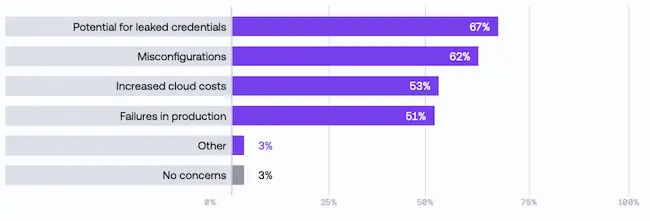
What concerns do you have about providing AI agents with access to cloud environments? (Source: LocalStack)
Respondents cite potential credential leaks, misconfigurations, increased cloud costs and production failures as concerns about granting agents access.
Developers are frustrated with the speed and reliability of cloud environments. Building, iterating and debugging cloud applications requires testing code updates in staging. Provisioning remote infrastructure adds delays through latency and setup complexity.
Sharing staging environments can create further disruptions. Developers often take turns pushing changes to avoid conflicting updates that can crash the environment. Most respondents who share these environments say downtime interrupts their work at least once a week.
“AI is generating code faster than teams can confidently ship it, making testing and validation the new bottleneck. We help developers and AI agents close this gap with fast, safe, isolated cloud environments that enable rapid iteration without the risks and costs of traditional cloud infrastructure,” said Waldemar Hummer, LocalStack CTO.
Testing misses production problems
Staging environments struggle to replicate production conditions, leaving defects undetected before deployment. Ninety-seven percent of respondents report production failures that staging environments cannot reliably catch.
These include network and connectivity issues, differences in resource limits and quotas, secrets and configuration drift, DNS resolution differences, and failed identity and access management policies.
Developers express more concern than managers about bugs and the effort needed to debug AI-generated code. Their responses suggest that perceptions of AI’s impact vary by role in the development process.