



Swati KhandelwalNov 19, 2026Vulnerability / Database Security Low-privilege database accounts that cannot read a single application table can still be used to run code on the database server itself, a researcher has shown, by reaching memory-corruption bugs in the engine code behind ordinary SQL. The exploits, published yesterday, are the researcher’s proofs of concept against […]
Swati KhandelwalNov 19, 2026Vulnerability / Database Security

Low-privilege database accounts that cannot read a single application table can still be used to run code on the database server itself, a researcher has shown, by reaching memory-corruption bugs in the engine code behind ordinary SQL.
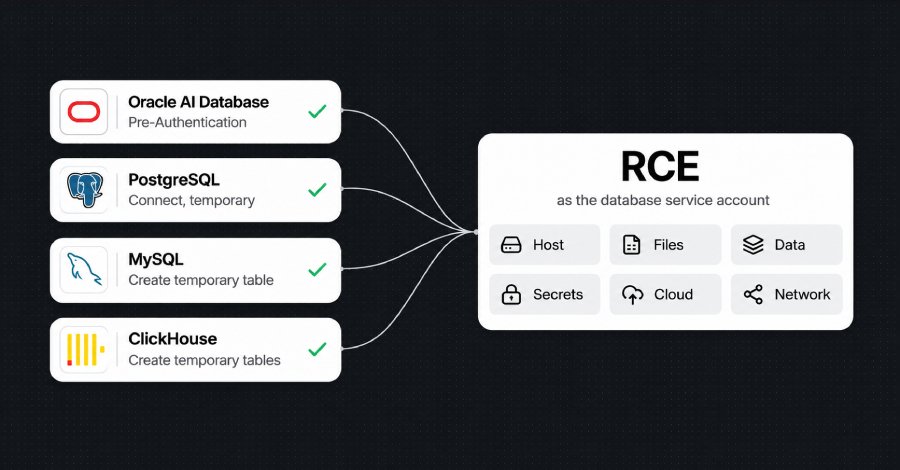
The exploits, published yesterday, are the researcher’s proofs of concept against PostgreSQL, MySQL and ClickHouse, plus a separate Oracle chain that needs no login. None has been seen in a real attack.
The work is by Zheng Yu, a researcher at Depthfirst. A database account’s SQL permissions control which tables and schemas it can access, the researcher argues, not the memory-unsafe C and C++ code the engine runs to read, plan, and execute a query.
Common grants give an account enough room to reach that code. PostgreSQL’s default TEMPORARY privilege, or the right to create temporary tables in MySQL and ClickHouse, allows an account to create objects or send input that triggers a memory bug.
Four of the flaws now have vendor CVEs and fixes, but the full attack chains were not reproduced independently, and the research reports no sign that any of them has been used in an attack.
In PostgreSQL, the flaw CVE-2026-116331 allows an account that can create database objects to run code as the operating system user that runs the database.
It was fixed last week in a security advisory, and the CVE record credits the researcher for the report. The researcher’s technical analysis shows a plain login role building the objects it needs in its own temporary schema, without touching application data, then turning a type-confusion bug into control of the server.
MySQL has a similar flaw in its query optimizer, CVE-2026-101786, in Server and Cluster versions 26.7.0 to 26.7.1. Oracle’s MySQL October advisory rates it as needing high privileges.
The researcher reached code execution on the 26.7.0 image with an account that could only create temporary tables and could not read existing ones, a narrower kind of access than that rating suggests.
Oracle Database is the one case where an attacker needs no account at all, the researcher says. A bug in Oracle Text and a flaw in the GraphQL interface of Oracle REST Data Services, chained against an exposed web endpoint, reach the engine code and run commands before any login.
Oracle patched the Oracle Text bug, CVE-2026-114819, rated 9.9, earlier this week in its November update, and the GraphQL flaw, CVE-2026-91609, in the October update. On their own, the company rates neither as exploitable without a login.
ClickHouse is the fourth target. The researcher reports an integer-overflow write in how it reads a binary row format, reached by a user who sets a single option, format_binary_max_string_size, to zero, and reproduced a shell on version 26.7.5.10.
This one has no CVE and no confirmed fixed version, so operators should check with the vendor for the fix.
| Software | Identifier | Affected versions | Fix |
|---|---|---|---|
| PostgreSQL | CVE-2026-116331 | Versions before 18.7, 17.12, 16.16, 15.20, 14.25 | Fixed November 12 |
| MySQL Server and Cluster | CVE-2026-101786 | 26.7.0 to 26.7.1 | Fixed October 20 |
| Oracle Database (Oracle Text) | CVE-2026-114819 | 19.3-19.32, 21.3-21.24, 23.4.0-23.26.3 | Fixed November 17 |
| Oracle REST Data Services | CVE-2026-91609 | 24.2.0 to 26.2.1 | Fixed October 20 |
| ClickHouse | No CVE assigned | 26.7.5.10 tested | No confirmed fixed version |
Beyond installing the updates, the other move is to review what accounts can do, not only what they can read, and to take away the TEMPORARY privilege and broad temporary-table rights from accounts that do not need them. That step does not close the Oracle path, which starts without any account.
Found this article interesting? Follow us on Google News, Twitter and LinkedIn to read more exclusive content we post.