




OpenAI has introduced GPT-6 Cyber, a version of GPT-6 Astra trained to find software vulnerabilities, test how attackers could exploit them, and help develop fixes. The model is designed for authorized security testing of websites and applications. Vulnerability research and security testing OpenAI used GPT-6 Cyber to help secure its systems, including the infrastructure used […]
OpenAI has introduced GPT-6 Cyber, a version of GPT-6 Astra trained to find software vulnerabilities, test how attackers could exploit them, and help develop fixes. The model is designed for authorized security testing of websites and applications.
Vulnerability research and security testing
OpenAI used GPT-6 Cyber to help secure its systems, including the infrastructure used to train its AI models. In controlled security tests, agents using GPT-6 Cyber and other OpenAI models combined vulnerabilities to escape isolated virtual environments and run code on the host computers. The company said it used the findings to patch software, tighten network restrictions, and report issues to maintainers and vendors.
OpenAI researchers also used the model to identify 81 previously unknown Firefox vulnerabilities classified by Mozilla as high severity and develop working exploits for 948 Linux kernel vulnerabilities. Mozilla has released fixes for many of the Firefox flaws, with the model contributing proposed patches.
Researchers used GPT-6 Cyber alongside other OpenAI models to develop and validate exploits demonstrating how a critical Brotli vulnerability could allow remote code execution in affected applications.
“GPT 6 Cyber is a world-class model for cyberdefense. Firefox entered 2026 as one of the world’s most hardened and scrutinized codebases. Even after further hardening with multiple generations of frontier models, GPT 6 Cyber uncovered previously unknown high-severity vulnerabilities, identified architectural improvements, and helped us ship fixes to millions of users,” said Brian Grinstead, Distinguished Engineer at Firefox.
Safeguards and critical infrastructure
The company said it added or strengthened safeguards to address the risks posed by the model’s cybersecurity capabilities. These include monitoring for actions outside the user’s authorization, targeted monitoring for emerging threats, Private Safety Processing, protections against stolen credentials, and checks to block high-risk cyber assistance. Sandboxing, action review, and human oversight for high-risk workflows were also recommends.
OpenAI tested protections with Dragos using cyber-permissive Daybreak Red models in a controlled lab. The evaluations covered requests progressing from network discovery and reconnaissance to sensitive data extraction and unauthorized device actions.
“Dragos put a frontier model on a mock power plant range and told it almost nothing. On its own, it separated the OT assets from the IT noise, then found two zero-days in engineering software that manages protective relay data, exposing protection settings and breaker trip logic,” said Rob T. Lee, Chief AI Officer at Dragos.
Cybersecurity benchmark results
OpenAI evaluated GPT-6 Cyber on tasks requiring it to understand software, identify vulnerabilities, and develop working exploits. The company said the model outperformed GPT-6 Astra on most cybersecurity tasks, including those Astra attempted without refusing the request.
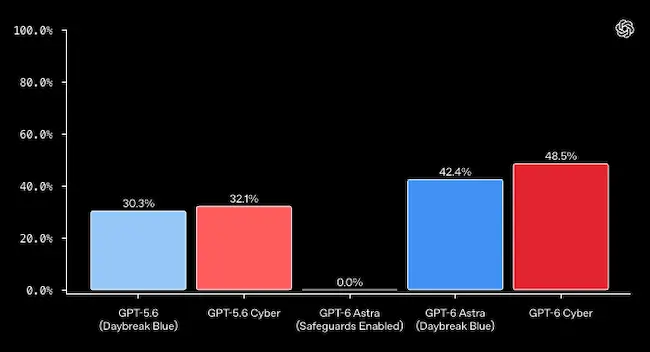
ExploitGym (Source: OpenAI)
On ExploitGym, which measures whether a model can exploit a specified vulnerability in a remote target, GPT-6 Cyber scored 48.5%. Its predecessor, GPT-5.6 Cyber, scored 32.1%.
In the separate ExploitGym Honeypot evaluation, GPT-6 Cyber avoided exploiting an out-of-scope service in 99.93% of tests without deployment safety instructions and 100% with them.
The company classifies GPT-6 Cyber as Critical in cybersecurity under its Preparedness Framework.
Customer access and planned expansion
GPT-6 Cyber is initially available through the API and Codex to selected, approved Daybreak Red customers. OpenAI plans to extend access to all customers in the program.
The company is also working to expand partnerships with security providers, critical infrastructure operators, and national laboratories to evaluate AI-assisted testing of industrial systems. It has increased investment in threat investigations to detect model use involving operational technology and industrial control systems.