






Cloudflare released a preview of Clairic, an extraction model that pulls typed values out of messy text and images in one pass without generating tokens. In Cloudflare’s test on a damaged-product support claim, a pipeline built around Clairic finished in 19.3 seconds, against 61.7 seconds for a version that used an LLM at every step, […]
Cloudflare released a preview of Clairic, an extraction model that pulls typed values out of messy text and images in one pass without generating tokens. In Cloudflare’s test on a damaged-product support claim, a pipeline built around Clairic finished in 19.3 seconds, against 61.7 seconds for a version that used an LLM at every step, and cost 49% less.
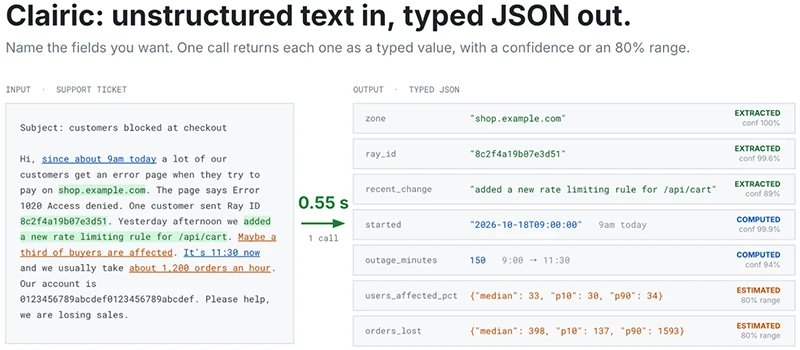
Clairic goes after a job developers routinely hand to large language models: read this invoice and return the order number, total and due date as JSON. Those calls fail in ways that are hard to spot. An LLM can emit broken JSON, misread a digit while writing it out, or return an excerpt with no pointer back to the source. Teams stack parsers, schema checks and retries on top, and pay output tokens for every field.
What comes back
Clairic runs on Workers AI as @cf/cloudflare/clairic, and Cloudflare plans to publish the weights. A developer sends text, up to four images and a list of named fields, each with a type such as number, date, list or estimate. Answers arrive as a value of that type or as null. Scalar answers carry a confidence score and p_null, the model’s probability that the value is missing from the input, and extracted text comes with character offsets. Cloudflare charges only for input.
In a sample customer email, Clairic added a $649.00 price and $52.10 tax to return $701.10, a total the email does not state. It counted 11 days between delivery and the date the customer wrote. Asked for a tracking number the email did not contain, it returned null. Its fallback guess, at 0.42 confidence, was the tax.
The speed numbers come from one workflow
In the claims test, Clairic extracted the facts in 0.46 seconds, and Clef, Cloudflare’s model for choosing among listed options, picked refund or repair in 0.22 seconds. GLM-5.3, the LLM in the comparison, needed 38 seconds for the same two steps. Both versions used GLM-5.3 to write the reply, which took 18.6 of the cascade’s 19.3 seconds. The cascade cost $6,032 per million claims, against $11,740.
Both pipelines got the facts and the decision right in each run Cloudflare reported. Clairic’s repair estimate held steady, while GLM-5.3 gave $250, $250 and $220. Gemma 4 and Qwen, run as all-LLM pipelines, could not derive the repair cost.
Cloudflare also asked Clairic for the next day’s TSA checkpoint count at U.S. airports, 21 days in a row. The forecasts missed by 3.3% on average, and 17 of the 21 actual counts landed inside Clairic’s 80% interval. A calibrated 80% interval should catch about 17 of 21, so the model hit its own target. Three of the four misses fell on the Columbus Day weekend, a holiday the traffic history gave the model no way to see.
Where it still breaks
Cloudflare calls the endpoint an early checkpoint. One- and two-step calculations look reliable, but longer chains of dependent arithmetic and sums across many table rows do not, and the company advises letting code do the math. Intervals can run narrow on unfamiliar data, and Cloudflare says the forecasting cannot replace a time-series model trained on the data in question.
“The architecture makes every answer well formed, not necessarily correct,” wrote Cloudflare experts.
The tracking-number case shows where that bites. A pipeline that read the guess field would have stored the $52.10 tax as a tracking number. The null value and a p_null of 1 are the signals that it wasn’t one.