





Astelia has announced autonomous network mitigation, a new capability that defends against AI-driven exploits by blocking attack paths to reachable vulnerabilities at the network level. Organizations can now eliminate the 1% of vulnerabilities attackers can reach without waiting for a patch. The mitigation workflow · 6 steps, 1 approval branch (Source: Astelia) Frontier AI models […]
Astelia has announced autonomous network mitigation, a new capability that defends against AI-driven exploits by blocking attack paths to reachable vulnerabilities at the network level. Organizations can now eliminate the 1% of vulnerabilities attackers can reach without waiting for a patch.
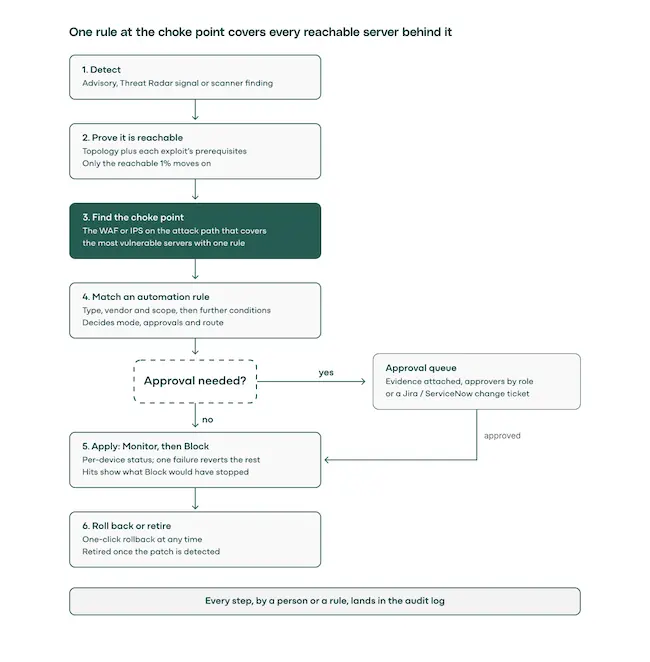
The mitigation workflow · 6 steps, 1 approval branch (Source: Astelia)
Frontier AI models have cut the time to exploit to almost zero. Manual triage and remediation can’t keep up, so organizations need to automate how they respond. Autonomous remediation has become the industry’s latest buzzword, but it isn’t a viable option for large enterprises, where every patch needs a change window so it doesn’t break important business processes. Often, there is no patch to apply at all because the vendor hasn’t released a fix yet, or, for older and end-of-life systems, never will.
Blocking threats at the network level avoids both problems and keeps pace with AI-driven exploits. Instead of changing the vulnerable system, Astelia blocks the path an attacker would use to reach it, automatically and within policies the organization sets, without waiting for a ticket or a change window. Nothing on the asset changes, so business-critical systems, including OT, stay online. It works whether or not a patch exists.
This approach is built on Astelia’s reachability analysis. Astelia maps the organization’s real network topology and uses agentic AI to analyze what each exploit requires. By correlating those exploit conditions with the topology, it determines which vulnerabilities attackers can reach, and through which paths. In one enterprise deployment, approximately 40 million vulnerabilities came down to fewer than 2,000 that were reachable.
For each reachable vulnerability, Astelia uses the same topology to find the most effective choke point on the attack path, then drives the mitigation there through the organization’s WAF or IPS/IDS. A single rule at that point protects every vulnerable server behind it, where patching would take one change per server. Because Astelia only mitigates paths it has proven reachable, it doesn’t add rules for exposure that doesn’t exist. Initial support covers WAF and IPS/IDS rules, with firewall rules planned.
Unlike a patch, which can break a system and can’t always be undone, every mitigation Astelia applies can be rolled back, so teams can act quickly without putting business operations at risk.
Each organization sets the guardrails. Through Astelia Agents, teams set up a dedicated autonomous network mitigation agent that applies mitigations on its own within the policies they define, and connect it to their other agents to respond to urgent threats such as zero-days and critical disclosures like the PHP2Shell remote code execution flaws of October 2026, which left end-of-life PHP servers with no official fix.
Teams can require human approval for specific environments or actions, and every action is logged and auditable. Astelia’s analysis continues to run on read-only integrations, and mitigation actions use scoped permissions that each organization enables and controls.
“For years, security teams have been told to patch faster,” said Alon Noy, CEO of Astelia. “That advice stops working when the exploit arrives before the change window does. The same network data that tells us a vulnerability is reachable tells us where to cut it off, so we block it there automatically and the exposure is closed before an attacker can use it.”